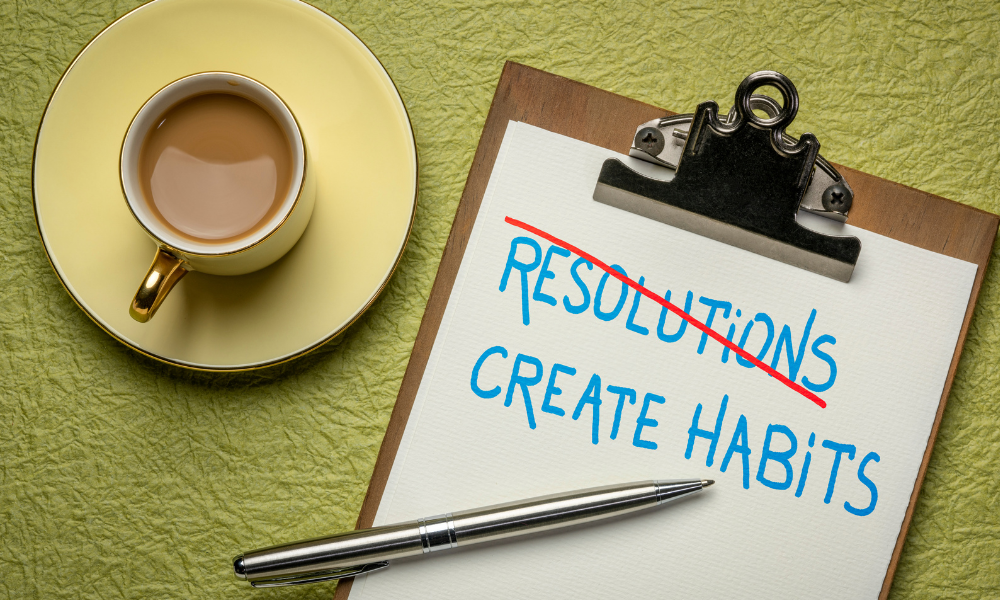
You’ve fallen off your wellness routine again, and you’re probably blaming yourself. But research shows it’s usually the plan that failed, not you. Here’s why complicated routines collapse, and what actually works when you’re starting over.
Key Takeaways
- Falling off a wellness routine is rarely a willpower problem – it’s usually a design problem. The plan was too complicated to survive real life.
- Neuroscience confirms that small, repeated actions build stronger habits than large, dramatic overhauls.
- A structured, step-by-step approach – like the one inside Zen Quest Living’s Wellness Reset Kit – makes it easier to rebuild consistency without the overwhelm.
- Progress, not perfection, is what actually drives long-term change. Setbacks are data, not defeat.
- Read on to see how the 7-step framework breaks down into manageable stages – and why the order matters.
Have you ever looked at a calendar and realized it’s been weeks since you did the things that made you feel your best?
Maybe you were walking every morning.
Preparing healthier meals.
Getting enough sleep.
Taking a few quiet moments for yourself.
Then life happened.
A vacation.
A busy week at work.
Family responsibilities.
One missed day quietly became two.
Before long, you found yourself thinking…
“I guess I have to start all over again.”
If you’ve ever felt that way, I want you to know something.
You are not failing.
You’re simply living a real life.
And real life doesn’t always follow perfect routines.
I’ve Been There Too
There have been times when I was juggling work, family, financial stress, and trying to hold everything together.
The last thing I needed was another wellness program telling me to wake up at 5:00 a.m., meal prep for seven days, and spend an hour exercising every morning.
I wasn’t looking for more to do.
I was looking for something I could actually stick with.
That realization completely changed the way I think about wellness.
Falling Off Is a Signal, Not a Verdict
There’s a quiet but important truth buried under every abandoned meal plan and forgotten gym streak: the routine was the problem, not the person. A wellness plan that demands a complete lifestyle overhaul on day one is not built to last. It’s built for the version of you that has unlimited time, zero stress, and nothing else on the calendar. That version rarely shows up.
Falling off track signals that the system needed adjusting – not that the person needed replacing. Understanding this distinction is the first real step toward building something that actually sticks.
Why Complicated Wellness Plans Often Break Down
The Limits of Willpower
Many people assume that sticking to a wellness plan is purely a matter of willpower. Research on this topic is more nuanced: while some studies suggest willpower can feel depleted over the course of a day – a concept sometimes called decision fatigue – more recent work indicates that beliefs about willpower play a significant role in how it functions.
What’s clear across the research is that any plan requiring constant conscious effort and sustained motivation is working against how the brain naturally operates.
When a routine is complicated, every step demands a deliberate decision. Eventually, the brain opts out.
Think about what happens after a long, exhausting day.
You’ve answered emails.
Solved problems.
Taken care of everyone else.
When you finally get home, your brain isn’t looking for another difficult decision.
It’s looking for easy.
That’s exactly why simple habits are so powerful.
The easier something is to do, the more likely you’ll keep doing it—even on the days when motivation is nowhere to be found.
The fix is less friction. The easier a healthy behavior is to perform, the less mental effort it requires – and the more likely it becomes automatic over time.
The All-or-Nothing Trap
All-or-nothing thinking turns a single missed workout into full permission to abandon the entire plan. It sounds like: “I already missed Monday, so the week is ruined.” This cognitive pattern is one of the most common reasons people repeatedly start over instead of simply continuing.
Sustainable wellness doesn’t have an off switch. Missing one day is a pause, not a reset. The goal is to shrink the gap between falling off and getting back on – and that only happens when the routine is small enough to return to easily.
Small Steps Are Scientifically Smarter
What Research Actually Says About Habit Formation
Neuroscience research confirms that habits form through repeated neural loops – a cue, a routine, and a reward. These loops are strengthened through repetition, not intensity. A single dramatic effort doesn’t build a habit. Fifty small, consistent actions do.
A widely cited study published in Health Psychology found that people who made smaller, more manageable changes were more likely to stick with new habits and see measurable improvements in overall health. A large-scale study involving nearly 60,000 older adults found that just five extra minutes of sleep, under two minutes of added daily activity, and a modest diet improvement could statistically add a full year to lifespan. Small inputs, compounded over time, produce real outcomes.
Dr. BJ Fogg, behavioral scientist and creator of the Tiny Habits method, puts it simply: habits are more likely to stick when they are small and tied to existing routines. The brain doesn’t need to be overwhelmed – it needs to be nudged.
Why Tiny Changes Outlast Big Overhauls
Big wellness overhauls feel motivating on day one. By day ten, when life gets busy, they collapse under their own weight. Small changes don’t trigger the same resistance. They’re manageable enough to continue even on hard days – and that consistency is what actually rewires behavior.
Research also challenges the popular myth that habits take 21 days to form. A study published in the European Journal of Social Psychology found the average time for a health-related habit to become automatic is closer to 66 days, ranging anywhere from 18 to 254 days depending on complexity. The simpler the habit, the faster it sticks.
The 7-Step Wellness Journey, Explained
Zen Quest Living’s Wellness Reset Kit organizes the rebuilding process into seven guided steps – each one designed to build naturally on the last, without requiring everything at once.
Step 1 – Reset: An Honest Starting Point
Step 1 is about getting clear on where things actually stand. Not where they should be, or where they were six months ago – where they are right now. This honest baseline is what makes everything else realistic. Without it, most people either set goals that are too ambitious or skip the areas that need the most attention.
Steps 2 Through 6: The Active Rebuilding Phase
Steps 2 through 6 form the core rebuilding phase, each targeting a specific layer of sustainable wellness:
- Step 2 – Rebuild: A structured 14-day reset plan focused on building healthier habits gradually, without overwhelm.
- Step 3 – Recharge: Using a tracking system to understand personal energy patterns and daily habit rhythms.
- Step 4 – Energize: Identifying what drains energy and building a simple plan around what genuinely restores it.
- Step 5 – Reduce Stress: Practical strategies to reduce overwhelm and create more calm – not through elimination, but through better management.
- Step 6 – Create Healthy Rhythms: Building morning and evening routines that make consistency feel natural rather than forced.
This middle section is where most of the actual habit-building happens. The steps are intentionally sequenced – addressing energy and stress before layering in new routines – because adding new behaviors onto an already depleted system rarely works.
Step 7 – Thrive: Building for the Long Term
Step 7 shifts the focus from rebuilding to sustaining. A long-term wellness plan takes shape here, along with self-care practices that support ongoing consistency. The emphasis is less on adding more and more on protecting what’s already working.
One Habit at a Time Beats Everything at Once
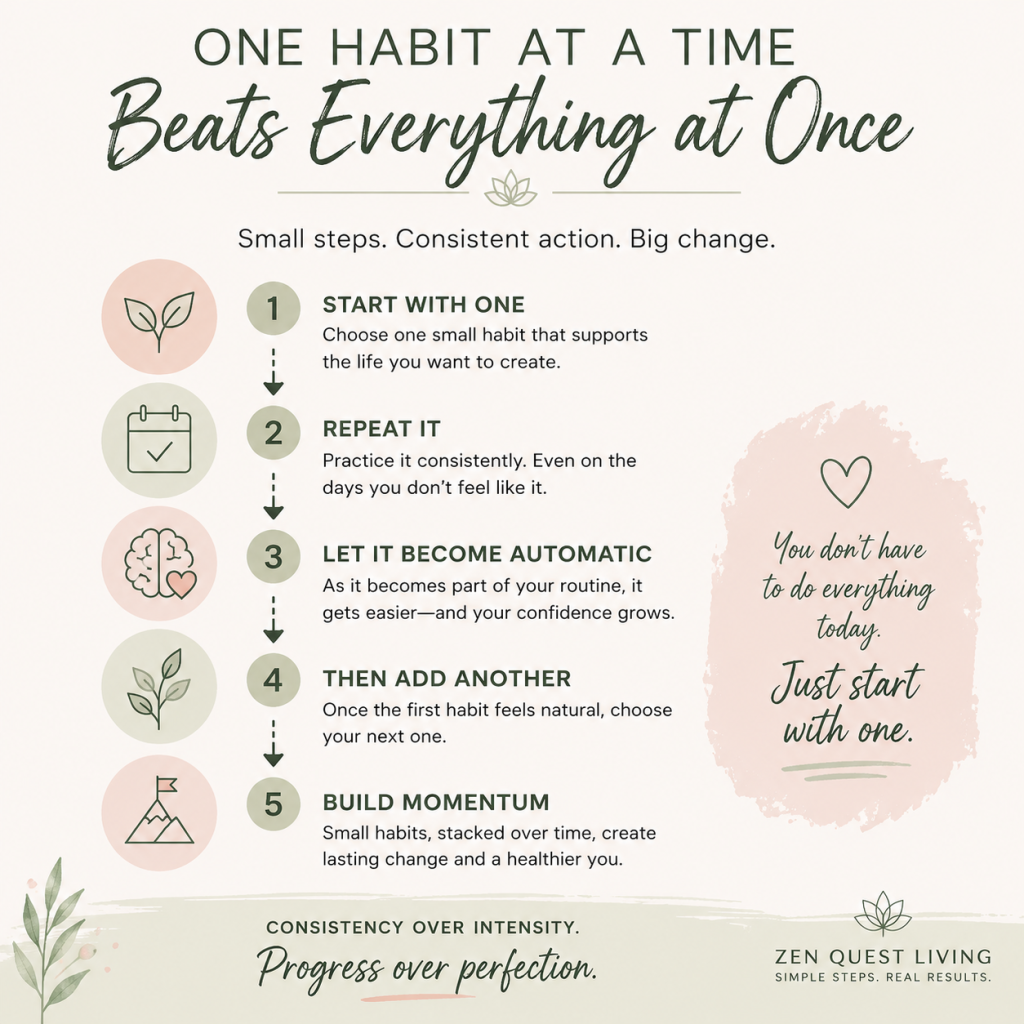
Habit stacking – linking a new behavior to an existing routine – is one of the most well-supported strategies in behavioral science. Something as simple as stretching after brushing teeth uses an already-established neural pathway, making the new behavior far easier to adopt and maintain.
The instinct when restarting is to do everything immediately: drink more water, sleep earlier, exercise daily, eat better, meditate – all at once, starting tomorrow. That instinct is what creates overwhelm. Focusing on one habit at a time, until it becomes automatic, is slower in theory and dramatically faster in practice.
Progress Over Perfection Is the Only Rule
Reframing Setbacks as Data, Not Defeat
A missed day is information, not evidence of failure. Why did it get skipped? Was the habit too time-consuming? Did it conflict with something else? Was the cue unclear? These are design questions, not character questions.
Cultivating a growth mindset – challenging the internal narrative that a setback means quitting – is one of the strongest predictors of long-term success. Reframing slips as feedback keeps momentum going instead of resetting it to zero. The goal is a durable streak, not a perfect one.
Behavioral science broadly supports this principle: treating imperfection as part of the process – rather than a reason to stop – is associated with stronger long-term habit maintenance. Consistency across months always outperforms intensity across days.
Start Today – Your Reset Is One Small Step Away
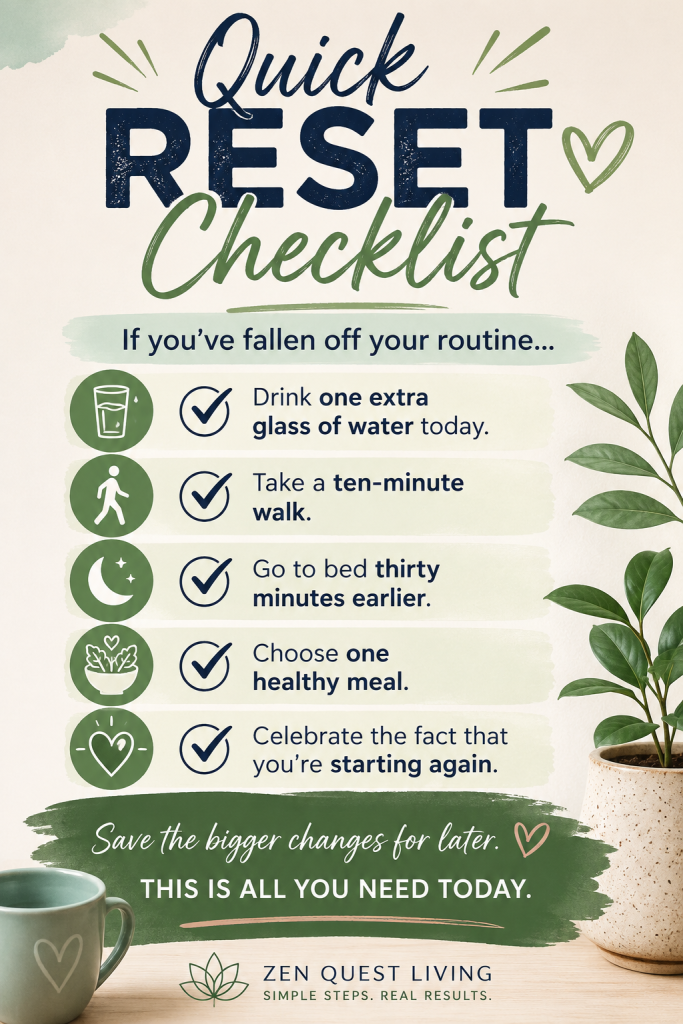
Getting back on track doesn’t require a perfect Monday, a clean slate, or a complete lifestyle change. It requires one small, honest starting point – and a system simple enough to follow through on.
The science is clear: small, consistent actions compound into meaningful change. The all-or-nothing approach doesn’t fail people because they’re not trying hard enough. It fails because it was never built for the reality of a busy, imperfect life.
Falling off isn’t the end of the story. It’s just a signal to simplify the next chapter.
One of the biggest myths in wellness is that missing a few days means you’ve failed.
You haven’t.
You’ve paused.
There’s a huge difference.
You don’t need another perfect Monday.
You don’t need a brand-new planner.
You don’t need to wait until next month.
You simply need one small step today.
Because healthy people don’t succeed by never falling off track.
They succeed because they learn how to begin again.
Zen Quest Living creates practical wellness tools and resources designed to help busy people build healthy habits through simple, sustainable systems – see what’s available at zenquestliving.com.