Most of us have heard it takes 21 days to form a habit that will actually stick. But, research has found that it actually takes an average of 66 days to form a habit – not 21.
Thats why making small, consistent changes works way better than trying to make dramatic overhauls.
Perfectionism is one of the biggest barriers to habit-building, often triggering an all-or-nothing mindset that leads to quitting entirely.
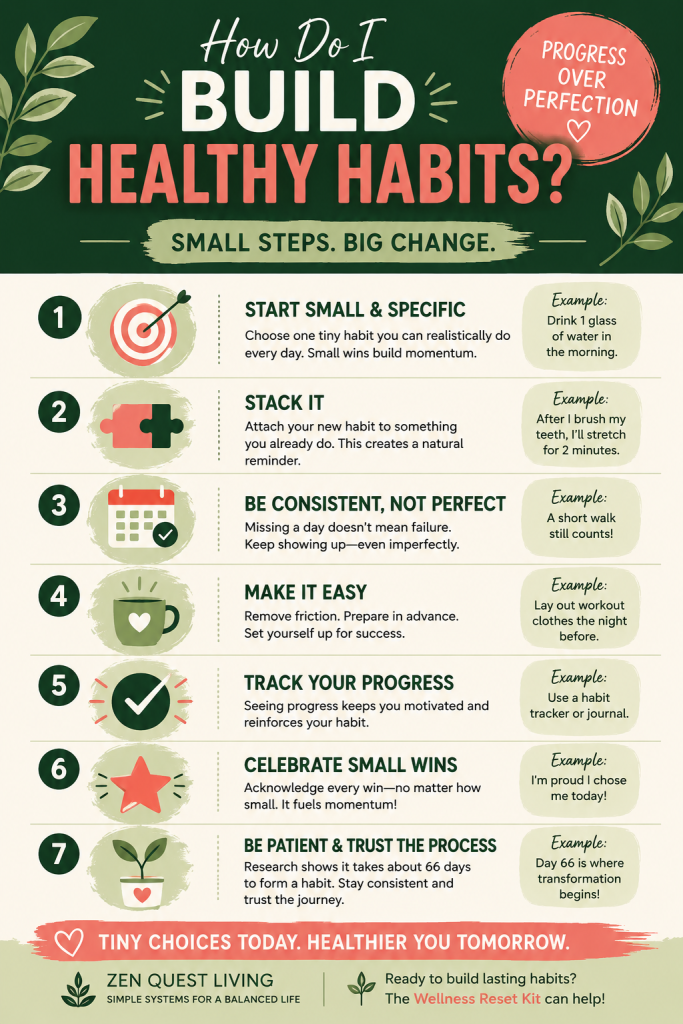
Habit stacking – attaching a new behavior to an existing routine – is one of the easiest and most effective ways for making habits stick.
Too many people quietly struggle – not because they lack willpower or desire, but because the approach itself is flawed from the start.
Most Wellness Routines Collapse Within the First Month
Think about the last time you tried a new wellness routine. How long did it take to fall apart? I’m sure you probably started with energy and optimism – a full schedule overhaul, a strict new diet, an ambitious morning ritual. Then life got busy, one day was missed, and the whole thing unraveled.
This pattern is incredibly common, and it’s not a personal failure. Most wellness plans are built around radical transformation rather than realistic, repeatable behavior.
When a routine is too complex or demanding, any disruption becomes a reason to abandon it entirely. The problem isn’t motivation – the system simply asks too much, too fast.
At Zen Quest Living, we understand this challenge. That’s why we create products from another direction – instead of expecting unrealistic, hard to stick with behavior changes, we create simple systems.
Why Small Steps Outperform Big Overhauls
The science here is clear. Small, sustainable changes lead to greater long-term impact because they require less effort and are far easier to maintain. When a habit feels manageable, it still gets done – even on hard days.
Habit Formation Takes Weeks to Months, Not Days
A widely cited study published in the European Journal of Social Psychology found that it takes an average of 66 days to form a habit – not the popular myth of 21 days.
That timeline matters. When people expect rapid results and don’t get them, they give up because they think something is wrong. And they’re right!
Starting small builds confidence and consistency during that critical window, making it far more likely the habit will actually stick.
Repetition Beats Relying on Willpower
Some research suggests willpower can be a finite resource, though studies also indicate that a person’s belief about willpower can influence its availability.
Either way, building a demanding wellness routine around raw willpower alone is a losing strategy. Small habits sidestep this problem – they don’t require heroic effort, just repetition.
Over time, repetition turns into routine, and routine turns into habit. That’s when lasting change actually takes hold.
Perfectionism Is the Real Habit Killer
Here’s something that doesn’t get said enough: perfectionism is not a virtue in habit-building – it’s a liability. The pursuit of a flawless routine creates a very fragile routine.
One skipped workout, one unhealthy meal, one missed journaling session, and its easy to feel like everything is ruined.
The All-or-Nothing Trap
This is the all-or-nothing mindset at work – a well-documented psychological pattern where anything short of perfect feels like total failure.
Research consistently shows that perfectionism prevents people from starting and continuing habits, because the bar is set so high that normal human inconsistency feels like defeat.
A better approach is simple: just focus on consistency and not on perfection.
As long as you show up regularly – even if it’s not perfect- you can build better habits. And that leads to permanent lifestyle change for the better!
A five-minute walk on a low-energy day still counts. A shorter meditation still counts. Doing something small beats doing nothing at all, every single time.
Simple Systems Beat Strong Motivation
Motivation fluctuates. Systems don’t.
Behavioral science consistently shows that a solid, easy and repeatable system – rather than raw willpower or inspiration – is the real power behind creating lasting habit change.
Habit Stacking: Attach New to Existing
One of the most practical and research-backed techniques is habit stacking.
The idea is straightforward: attach a new habit to an existing one.
After morning coffee, do five minutes of stretching.
After brushing teeth, write one thing to be grateful for.
The established routine acts as a natural cue, dramatically increasing the likelihood the new behavior gets done and becomes a habit.
This approach works because it doesn’t require carving out new time or remembering a new trigger – it piggybacks on what’s already automatic.
Small Wins Build Lasting Momentum
Acknowledging progress, no matter how minor, boosts motivation and reinforces the positive changes you’re making.
Each small win sends a signal to the brain: this is working, keep going.
That signal compounds over time, building the kind of internal momentum that external motivation just can’t compete with.
One Small Step Today Can Change Everything
You don’t need to wait until Monday.
You don’t need a new month.
And you sure don’t need the perfect plan.
You just need to take one small action:
- Drink one extra glass of water.
- Take a five-minute walk.
- Stretch while your coffee brews.
- Write down one thing you’re grateful for.
Those small choices may not seem life-changing today.
But they become something much bigger through consistency.
Research continues to point in the same direction: lasting habits are built through repetition, realistic expectations, and small daily actions—not huge, overnight changes.
A five-minute daily walk becomes a fitness habit.
One glass of water added to a morning routine becomes better hydration.
One earlier bedtime becomes improved sleep and more energy.
None of these are big or difficult to maintain.
But all together, over weeks and months, they fundamentally shift how you feel and function.
Small choices don’t look impressive on day one. But by day 66, they look like a different life.
How the Wellness Reset Kit Makes It Practical
Understanding the theory is one thing. Having a structured way to apply it is another.
That gap – between knowing what to do and actually doing it – is where most people get stuck, and where practical tools make a real difference.
One Habit at a Time, Seven Guided Steps
Our Wellness Reset Kit is built around a seven-step guided journey designed to walk you through meaningful change without becoming overwhelmed.
The steps move progressively:
- You start with a wellness reset to evaluate current habits
- Then you go to the rebuilding with a 14-day plan, recharging through a tracking system
- Next, you’re taught how to identify personal energy patterns and develop stress reduction strategies
- Then our simple system to create soothing morning and evening routines
- And finally create the perfect long-term wellness plan for you and your specific life needs.
Each step is intentionally sequenced so the focus stays on one area at a time – which is precisely what the research supports.
Tools That Track Progress, Not Perfection
The kit includes practical resources like a 30-Day Healthy Habit Tracker, a Wellness Goal Planner, and Wellness Journal Pages – all oriented around tracking progress, not measuring up to an impossible standard.
The goal isn’t a perfect record. It’s for you to be able to see your progress which reinforces consistency and that’s what makes habits last!
As one user noted after completing the kit: “It gave me valuable tools to create healthier habits to help achieve a greater sense of well-being… I felt refreshed, renewed, and better equipped to handle whatever comes my way.”
Start Small Today – Your Future Self Will Thank You
The biggest myth in wellness is that meaningful change requires a dramatic starting point – a Monday, a new year, a perfect morning. It doesn’t.
It requires a single small action, repeated.
Science backs this up.
Behavioral psychology backs this up.
And the lived experience of countless people who’ve tried the all-or-nothing approach – and watched it fail – backs this up too.
- Start with one habit.
- Stack it onto something already being done
- Track progress without demanding perfection
- Let the compound effect do the rest.
The results won’t be dramatic at first. That’s exactly the point. Sustainable change is built quietly, one small choice at a time – and those choices add up to something that actually lasts.
If you’re ready to stop starting over and build something that sticks, our Wellness Reset Kit is just what you’ve been looking for!